The short version
A kids birthday invitation needs four things: your child's name and age, the date, time and address, an RSVP deadline with a way to reply, and one line about food. Everything past that, a rhyme, a theme, a character, is decoration. Get those four right and the wording almost writes itself.
Below are three ready wordings for ages three to five, six to eight, and nine to twelve, the four required lines explained one at a time, and what changes if you are sending it as a text or a link instead of paper. Still deciding the day itself? Start with the party ideas by age, the ideas for a party at home and a party schedule you can put the start and end time from.
Want it written for you? The free invitation wording generator takes your child's name, age, time and place and puts the four lines in order, ready to copy into a card or a text.
What has to be on every invitation
A birthday invitation is a small piece of logistics wearing a party hat. Parents reading it are not looking for charm, they are looking for four facts in order: who is turning what age, when and where to be, when to reply by, and whether there is anything to bring or avoid.
| Line | What it answers | One example |
|---|---|---|
| Who, and how old | Name and age | "[Child] is turning 6" |
| When and where | Date, time, address | "Saturday, April 11, 1 to 3pm, 22 Maple Street" |
| Reply by | Deadline and a way to answer | "Text [phone] by April 4" |
| Anything to know | Food, allergies, what to bring | "Snacks provided, let us know about allergies" |
The order that gets read
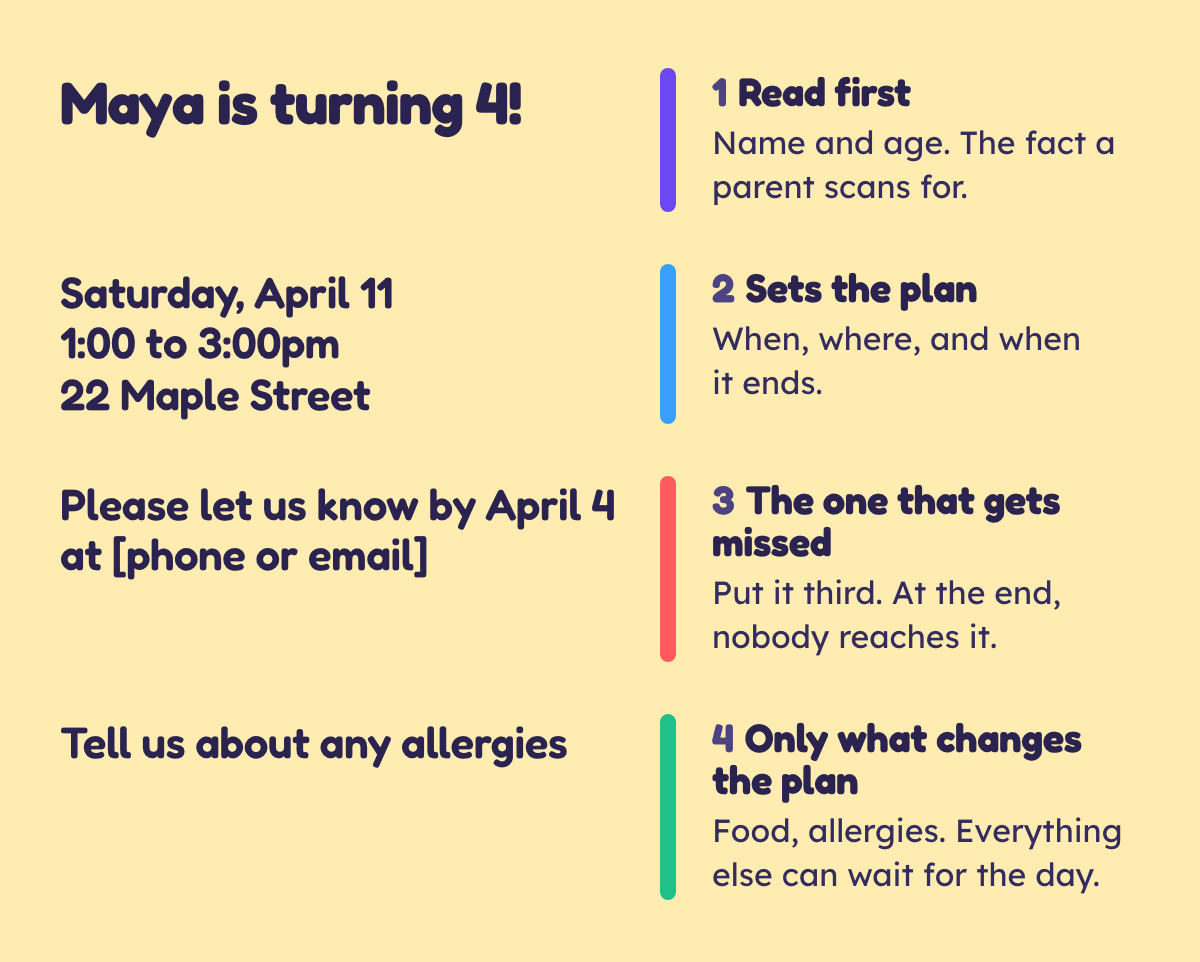
Put the four lines in this order and a tired parent reads the whole thing in one glance: the name and age first, because that is what makes them stop scrolling, then when and where, then the reply line, then anything extra. Reverse the order and the reply line is the one that gets missed.
Wording for ages 3 to 5
At this age the invitation is read by a parent, not the child, so skip the theme voice. State the age plainly. A three year old's party and a five year old's party are different logistics for the adults deciding whether older siblings come too.
- Plain. "[Child] is turning 4! Join us Saturday, April 11, 1:00 to 3:00pm, at 22 Maple Street. Cake, games and probably some mess. Please let us know by April 4, and tell us about any allergies, at [phone or email]."
- Themed, lightly. "[Child]'s turning 4 and going on a dinosaur hunt! Saturday, April 11, 1 to 3pm, 22 Maple Street. No costume needed. Reply by April 4 to [phone or email], and let us know about allergies."
- Short, for a text or group chat. "[Child] turns 4 on April 11! Party 1 to 3pm at ours, 22 Maple St. Let me know by April 4, plus any allergies. [phone]"
One line to keep at this ageSay the age out loud in the first sentence. It is the single fact a parent scans for first, before the date and before the theme.
Wording for ages 6 to 8
This is the age where the child might read the invitation themselves, so it can carry a little more personality without losing the facts. Keep the four lines in the same order, and let the theme show up in one phrase, not in every sentence.
- Straightforward. "[Child] is turning 7 and wants you at the party! Saturday, May 9, 2 to 4pm, 14 Birch Avenue. Please reply by May 2 so we know how much cake to order, and let us know about allergies."
- Theme hook up top. "Mission: [Child]'s 7th birthday. Report for duty Saturday, May 9, 2 to 4pm, 14 Birch Avenue. Reply by May 2, agents. Allergies noted on arrival, or tell us now."
- By text. "[Child]'s 7th is Sat May 9, 2 to 4pm at ours (14 Birch Ave). Can you make it? Let me know by May 2, and any allergies. Thank you!"
Wording for ages 9 to 12
At nine and up, cool matters more than cute. Cut anything that reads babyish, keep the wording short, and trust the four facts to do the work. If your child has a theme they actually asked for, one line of it is plenty.
- Direct. "[Child]'s turning 10. Saturday, June 6, 1 to 3:30pm, 9 Cedar Court. Reply by May 30 so we can plan food properly, and flag any allergies then too."
- One theme line, no more. "[Child] is turning 10, and it's a gaming afternoon. Saturday, June 6, 1 to 3:30pm, 9 Cedar Court. Let us know by May 30, plus any allergies."
The RSVP line everyone forgets
The line that gets left off is rarely the date. It is the method. 'RSVP' on its own asks for a skill most people no longer have; a real verb tells them exactly what to do. Text me by [date]. Call by [date]. Reply to this. Any of those gets answered faster than the word RSVP ever will.
Put a real deadline on it, not "soon," and put your phone number or email directly under the reply line so nobody has to hunt for the invitation again to answer it. If you want to know about allergies, ask it in the same breath as the reply, not as a separate note lower down; a parent who is already replying will answer it, a parent scrolling further usually will not. For when to actually send the invitation and how to chase the families who go quiet, the four week checklist covers the timing; this page is only the words.
Paper, a text, or a link
Paper still reads as the most considered choice, and it is the easiest thing for a grandparent to put on the fridge. A text is the fastest and the easiest to reply to, which usually matters more than the paper does. A digital invite sits between the two: sent as a link, it can hold the RSVP and the allergy question inside itself, so a reply comes back as an answer on your guest list instead of a text you have to remember to write down. KidBD sends its invitations this way too, as a sealed link each guest opens on their own phone, with the reply and any allergy note landing on your list automatically.
| Format | Best for | Watch for |
|---|---|---|
| Paper | A keepsake, and the fridge | The slowest way to get a reply back |
| Text or group chat | Speed, and a fast reply | One reply can get lost in a long thread |
| A digital invite link | Collecting the RSVP and allergies automatically | Needs a phone to open, true for nearly everyone now |
Five wording mistakes that cause a mess
- The age is missing.A parent deciding whether an older sibling comes, or whether to stay for the party, reads for the age first. "Turning 6" says more than any theme name does.
- "RSVP" with no verb and no date.It reads as optional. "Text me by April 4" is a request; "RSVP" alone is a hope.
- The address is assumed."Our place" works for family. For a classmate's parent who has never been, it is the line that turns into a text to you at 12:50 on the day.
- Allergies are buried in a PS.Ask it in the same line as the reply, not below a graphic nobody scrolls to.
- A rhyme hides the time."Come one, come all, to a birthday ball" is charming and unreadable at a glance. Say the plain thing first, and decorate it second.
Matching the theme without losing the four lines
A theme belongs in the wording once, not in every line. Write the plain version first: name, age, date, time, address, reply by. Then add one themed phrase at the top or the bottom, never inside the four facts themselves. "Dinosaur hunt this Saturday" above the plain details does more work than a whole invitation written in character voice, because the parent reading it still has to find the time and the address inside the joke.
Once the invitations are out and the replies are in, the next decision is what fills the middle of the party. Thirty birthday party games, sorted by age, covers that part.
Questions parents actually ask
What has to be on a kids birthday invitation?
Four things: your child's name and age, the date, time and address, a reply-by date with a way to answer, and one line about food or allergies. A theme or a rhyme sits on top of those four, and never replaces them.
How do I word an invitation for a three or four year old's party?
Keep it to the four lines and skip the theme voice. Parents are deciding logistics for a child who cannot read yet, so the plainer version gets read faster and remembered better than the clever one.
Should I put an RSVP deadline on the invitation?
Yes, and give it a verb. 'RSVP' alone asks for a skill most guests do not have; 'text me by [date]' tells them exactly what to do and by when, and it is the wording that gets the fastest replies.
Do I need to ask about allergies on the invitation itself?
Ask it in the same line as the reply, not as a separate note further down. A parent who is already replying to confirm will answer an allergy question right there; asked separately, it is the question that gets forgotten.
What changes if I send the invitation as a text or a link instead of paper?
Nothing about what it has to say, only how short you can make it. A text or a digital invite link can drop the pleasantries and lead straight with the date, because the reply button or the RSVP field is right there underneath it.